Crisis Studies of the Islamic World

Crisis Studies of the Islamic World

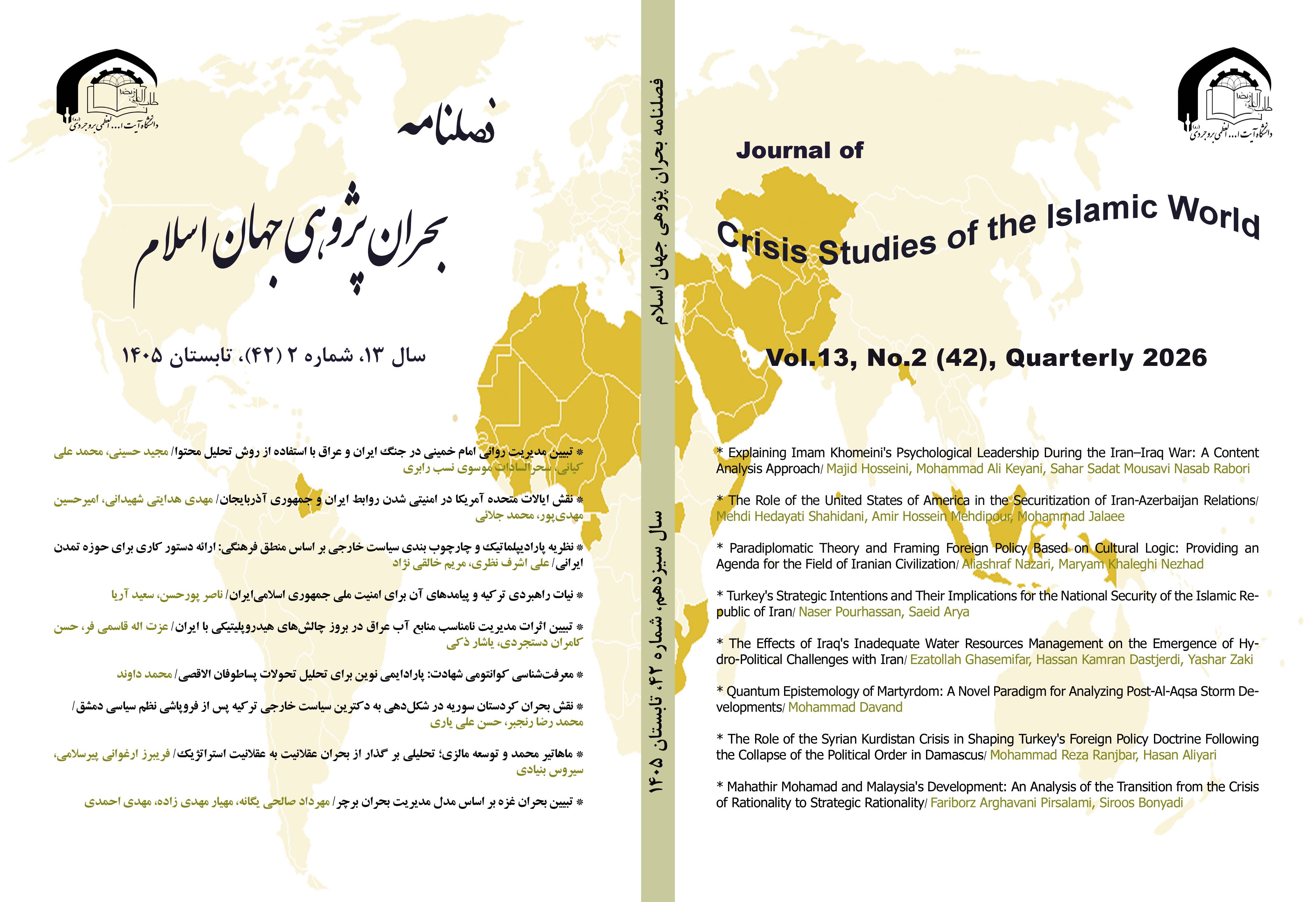
The Role of the Syrian Kurdistan Crisis in Shaping Turkey's Foreign Policy Doctrine Following the Collapse of the Political Order in Damascus

Document Type : Research Paper

Authors
1 Assistant Professor, Department of Islamic Studies, Payame Noor University, Tehran, Iran
2 Assistant Professor, Islamic Studies Department, Payame Noor University, Tehran, Iran
Abstract
Following the collapse of Damascus's political order, the Syrian Kurdistan crisis emerged as one of Turkey’s most significant security and geopolitical challenges, intensifying Ankara’s concerns over the growing influence of Kurdish groups. This situation, in various ways, prompted a transformation in Turkey’s foreign policy toward a more security-oriented and interventionist approach. This study adopts a qualitative methodology, utilizing document analysis and secondary sources to examine the relationship between the Syrian Kurdistan crisis and the evolution of Turkey’s foreign policy doctrine. Drawing on the theoretical framework of the Copenhagen School, the central hypothesis posits that the Syrian Kurdistan crisis not only constitutes a security threat to Turkey but has also played a direct role in redefining its foreign policy doctrine—shifting Ankara’s orientation from soft diplomacy to hard, militarized strategies. The findings reveal that the post-Assad Syrian crisis has led Turkey to strategically pivot from soft power to hard power, prioritize political-security efforts to combat terrorism, strive to preserve Syria’s territorial integrity and influence its future, safeguard border security, and engage in regional geopolitical engineering through interventionist policies.
Keywords

Volume 13, Issue 2 - Serial Number 42
Summer Quarterly
Summer 2026
Pages 216-243

  • Receive Date 16 October 2025
  • Revise Date 09 November 2025
  • Accept Date 23 April 2026